

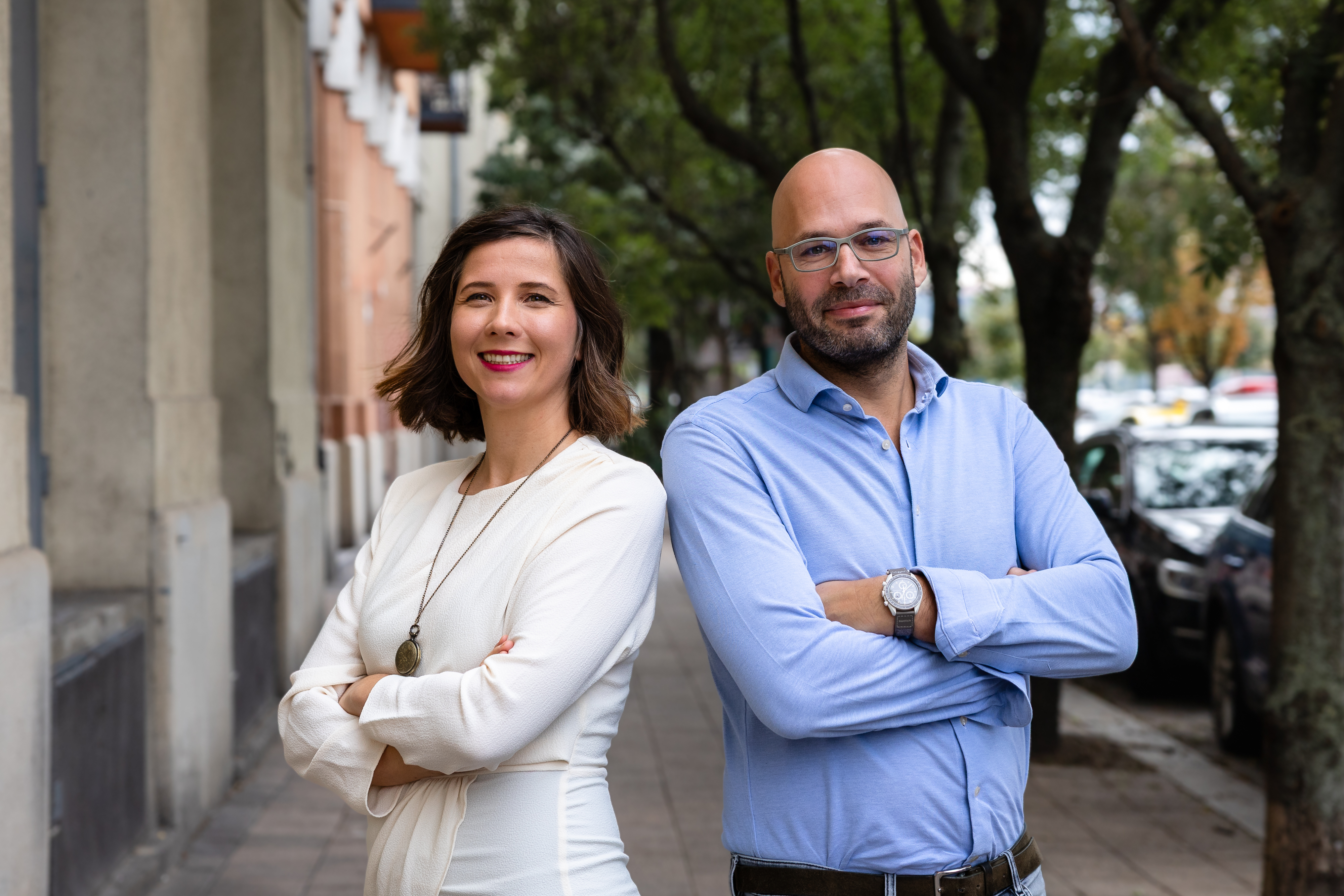
When did you decide to pursue a career in law? Was it a conscious choice, or more of a coincidence?
Dani: Already in high school it became clear that I could argue quite well. Originally, I wanted to be a doctor, but around the third or fourth grade I realised I would rather spare myself biology. I didn’t really have a better idea—and at the time, being a lawyer was still considered cool. It helped that I loved history, which was part of the entrance exam, so I ended up at ELTE.
Petra: I belong to a slightly younger generation; I completed a two-level high school diploma. I was the first in my family to go to university. My parents thought it would be safest for me to choose a “decent” profession: doctor, lawyer, or architect. Originally, I wanted to study art history, but in the end I changed my plans because of family pressure. Because of this, I didn’t have a strong sense of commitment at the beginning.
When did your paths first cross?
Petra: University was a disappointment for me; it lacked the great “universitas” feeling and the workshop culture I had imagined. However, I moved into the Bibó István College for Advanced Studies, which gave me a great deal as a first-generation lawyer originally from the countryside. I found myself in an environment surrounded by curious, engaged people, and we learned a lot not only in classes, but also from each other. Later, when I was a fifth-year intern at the international office of Weil, Gotshal & Manges, I heard about a “young titan.” That was how Dani was introduced to me.
Dani: Yes, we met at Weil. I was already working there after returning from the Netherlands, where I had studied EU law.
Petra: I remember that at first we literally ran into each other in the kitchen. Dani was making coffee; we talked for ten minutes, and then I said to a friend who was also working there at the time: I will either hate this guy very much, or I will like him very much. In the end, it turned out that we think very similarly—in ways that differ from the average lawyer.
International dispute resolution is a very specific field. When did you start gravitating toward it instead of more classic legal work?
Dani: For me, it was completely accidental. When I came home from the Netherlands, I originally wanted to work in competition law. At Weil, there was a major case—EDF v. Hungary, an investment protection arbitration. The Washington office was leading it, but they needed someone in Budapest who spoke English well and understood both the facts and EU law, so I started working on it. I was fully supported by my bosses at the time, Laci Nagy and Konrád Siegler, from whom I learned a great deal. I was later invited to Washington for a six-month secondment, and eventually I was offered a position there. I was simply in the right place at the right time.
Petra: I also started out in litigation at Weil, and later moved to White & Case with the clear intention of focusing exclusively on dispute resolution. I joined an excellent team. What I loved was that every case has its own story, written in real time—like an unfinished book. There is a constant sense of novelty and variety in dispute resolution that completely captivated me. I was fortunate, because in Hungary it’s rare to work continuously on international arbitration cases as a trainee and young lawyer but I was given that opportunity.
Dani, you spent several years in Washington and London. What did you bring home from that experience?
Dani: In Washington, I had to relearn how to write. In Hungary, we are taught that a legal text is good if it’s as complicated as possible. There, I learned the language of the American trial lawyer: simple, but extremely effective. We even had workshops where our pleadings were videotaped and every movement was analysed. I brought that efficiency and sense of presentation back with me to Queritius.

How was Queritius born? What “gap” in the market were you responding to?
Dani: Through our international contacts, we had been thinking for years about leaving the Big Law environment. We all had Western litigation experience, and we wanted to bring that knowledge back to the region. A single-country market is small, but by connecting the region we could build an international litigation boutique. Then, in March 2020, COVID hit. London went into lockdown, I moved back home, and in November I opened the Budapest office. The first thing I did was call Petra. At that time we were three; today we are twenty-three. In addition to Budapest, we now have colleagues in Zagreb, Belgrade, Kyiv, Warsaw, and Athens.
Petra: I was on maternity leave at the time, right in the middle of the pandemic. Dani had already reached out during my pregnancy, but I didn’t put myself forward then. When he came home, we spoke again—I remember meeting him for coffee with my six-month-old baby—and it felt completely natural to start thinking together.
You describe yourselves as a “boutique” firm. How does that differ from a large international law firm?
Dani: We don’t do transactions or bank financing where templates dominate. Every case we handle is unique, complex, and usually high-value. That’s why there are no easy days—and no reserve players. Everyone who works here is part of the A-team; anyone can be sent onto the pitch immediately.
Petra: The entry threshold is very high; you need a skill set that’s hard to acquire as a junior. As a result, our teams are very senior, which clients value highly. With us, the partner doesn’t appear at the beginning and then disappear. Whoever is “on the box” is also on the inside.

You’ve said your personalities are very different, yet highly complementary. How does that work in practice?
Dani: Petra leads litigation, while I focus more on arbitration. I’m primarily interested in the facts—I believe very few cases are decided by law alone; facts usually matter more. Petra, on the other hand, has a real fixation on the nuances of substantive and procedural law.
Petra: We laugh about this a lot. There was a case where Dani openly laughed at one of my procedural arguments—and then we won. The combination of creativity and precision makes us, in a good way, very unpleasant opponents.
Dani: Exactly. Petra is extremely kind as a person, but professionally she is a very unpleasant opponent. That mix of creativity and legal precision is a powerful weapon.
How does the human side show up in such an intense professional environment? Petra, you studied psychology, and Dani, you’re also a coach. Does that shape your work?
Petra: Absolutely. Legal excellence is only the entry point for us. We don’t just solve legal problems; we handle the human side as well. Disputes are always a crisis for the client, and it’s always stressful.
Dani: We don’t try to look clever in meetings. Many lawyers want to prove they know the law best; we spend about 90% of the time asking questions. If you ask the right questions, the client knows you are prepared. The other key element is trust, we are real. We don’t promise certain victory; we talk about probabilities. We have never lost a case without having identified the risk in advance.
This directness is also visible in your communication, for example in the Coffee Confidential video series. Is that intentional?
Dani: Law firm communication is usually boring. We offer reassurance in difficult situations, and reassurance starts with showing who we really are. If someone wants a lawyer in a suit and an iron helmet, they shouldn’t come to us. In the videos—often shot on an iPhone—we tell our own stories.
Petra: We don’t use an external marketing team. Everything comes from us; we stand behind everything. Our newsletter isn’t a dry legal summary either, it’s more like a magazine that decision-makers actually want to read. It’s teamwork: if someone has an idea, they have to pick up the baton and run with it.

You operate across several countries. How does international collaboration work in practice?
Dani: Our Serbian and Greek colleagues also work closely with the Budapest team, and we have daily online check-ins. Around 30–40% of our work involves international collaboration, which is very high.
Petra: We work on a project basis. Cases aren’t assigned to offices, but to teams—assembled individually for each matter. We put together the best possible combination of people based on experience, regardless of geography.
Petra, you became a partner while working part-time with a small child. How unusual is that in the market?
Petra: I think it’s unprecedented in Hungary. Very few firms support mothers in working part-time and still reaching partnership. At Queritius, diversity isn’t just a policy—it’s everyday reality. I’ve never worked with so many female colleagues before.
Dani: This isn’t charity; it’s sound business. Diversity pays. I benefit from pushing talented colleagues forward, because it reflects well on the entire firm. Petra isn’t a partner because she’s a woman—she’s a partner because she’s one of the most talented litigation lawyers within a thousand kilometres.
What are your plans for the future?
Dani: Globally recognised boutiques like Three Crowns or Lalive are benchmarks for us. One day, we want to be mentioned on the same page. We don’t want to grow into a firm of hundreds, we want to stay efficient, without ever compromising on quality.
Petra: Dispute resolution is becoming increasingly complex. Clients don’t just want a legal solution; they also want reputational and economic risks managed in one place. That’s where we’re heading towards integrated crisis management and dispute resolution.




0 Comments